Mold Inspection vs Mold Testing: What’s the Difference?
If you’ve searched “mold inspection vs mold testing,” you’ve probably already found mold in your home or at least suspect it ,and you’re not sure which service to book first. The two terms get used interchangeably online, but they’re not the same thing, they don’t cost the same, and booking the wrong one can waste both time and money.
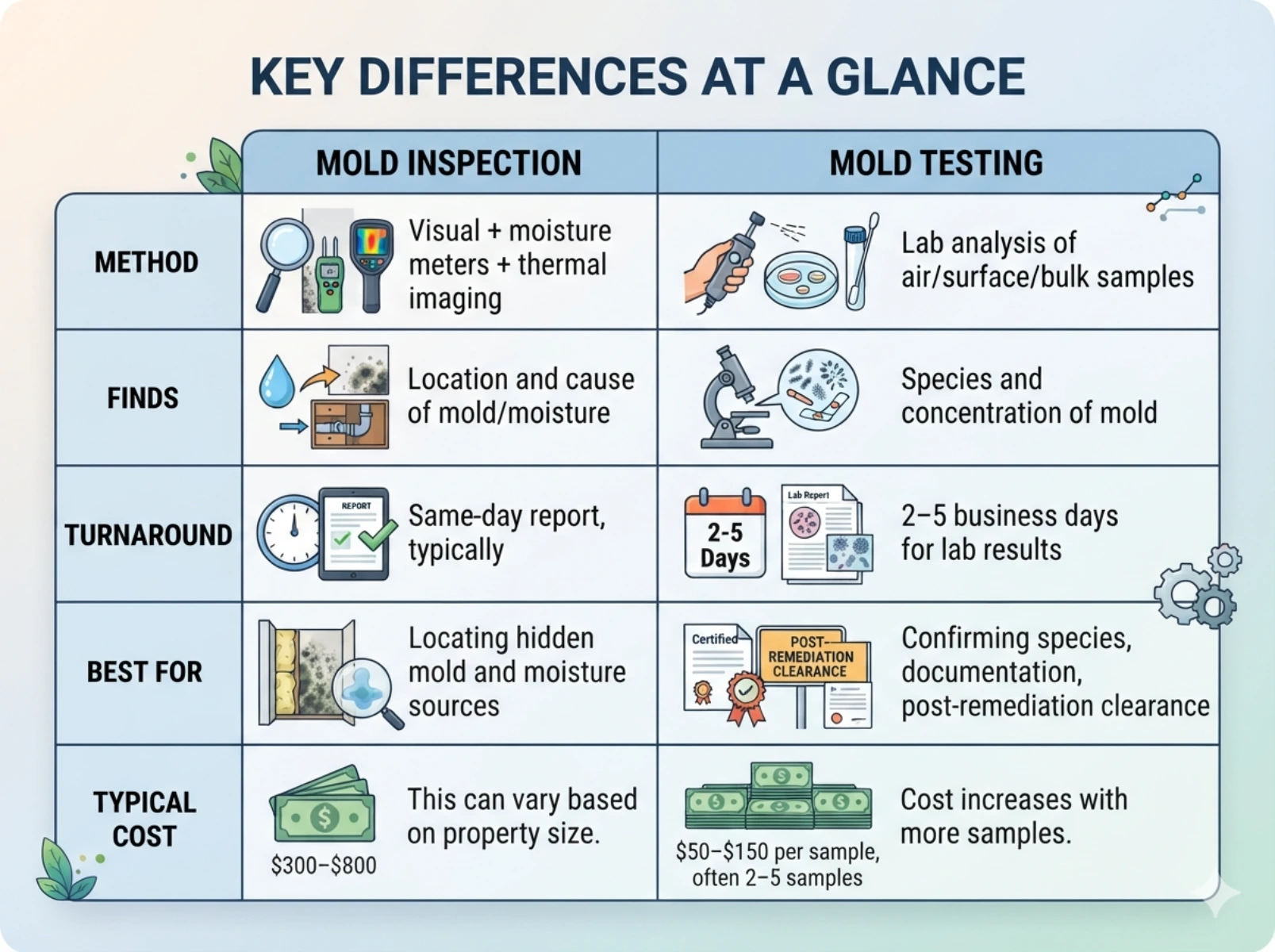
In short: a mold inspection is a visual and moisture-based investigation to find where mold is growing and why. Mold testing is a lab-based process that samples air or surfaces to identify exactly what type of mold is present and in what concentration. One finds the problem; the other confirms and quantifies it.
Here’s how they actually differ, when you need one versus the other, and what to expect from each.
What Is a Mold Inspection?
A mold inspection is a hands on evaluation of your property conducted by a trained inspector. The goal isn’t to name the mold species , it’s to find every place mold could be growing and identify the moisture source feeding it.
During a typical inspection, the inspector will:
- Walk the property room by room, checking high-risk areas like bathrooms, attics, crawl spaces, and basements.
- Use a moisture meter to check walls, flooring, and framing for elevated moisture content.
- Use thermal imaging to spot temperature differences that indicate hidden dampness behind walls or ceilings.
- Look for musty odors, staining, peeling paint, or warped materials.
- Identify the likely cause a roof leak, plumbing issue, poor ventilation, or high indoor humidity.
At the end, you receive a written report documenting what was found, where, and what’s causing it, along with recommendations for remediation or further testing.
A mold inspection answers the question: Is there a moisture or mold problem, and where is it coming from?
What Is Mold Testing?
Mold testing goes a step further. Instead of relying on visual assessment alone, it collects physical samples and sends them to an accredited laboratory for analysis. This is the only way to confirm the exact species of mold present and how concentrated it is compared to a normal outdoor baseline.
Common mold testing methods include:
- Air sampling : A pump draws air through a spore trap to measure airborne mold spore concentration, usually compared against an outdoor control sample.
- Surface sampling: Swabs or tape lifts collect material from a suspected mold patch for lab identification.
- Bulk sampling: A small piece of affected material (drywall, carpet, insulation) is removed and sent for analysis.
- ERMI/DNA testing : A more comprehensive dust-based test that screens for a broad panel of mold species.
Mold testing answers the question: Exactly which mold is this, and how much of it is present?
Mold Inspection vs Mold Testing: Key Differences at a Glance
Do You Need Both?
In most residential cases, an inspection alone is enough. If an inspector visually confirms mold and traces it to an active leak, the priority is fixing the moisture source and remediating ,testing to identify the exact species usually won’t change that plan.
Testing becomes worthwhile in a few specific situations:
- You smell mold but can’t see it. A persistent musty odor with no visible growth is the clearest case for air sampling to confirm whether spore levels are elevated and where.
- You need documentation. Real estate transactions, insurance claims, landlord-tenant disputes, or legal proceedings often require lab-verified results, not just a visual opinion.
- You have health concerns. If a household member has respiratory symptoms and a doctor wants to know what specific mold is involved, testing provides that data.
- You’re verifying remediation was successful. Post-remediation air or surface sampling confirms indoor mold levels have returned to normal before you consider the job done.
If none of these apply and mold is already visible, most professionals and the guidance from health authorities agree that testing adds cost without changing the outcome: find the moisture, remove the mold, fix the source.
What the EPA Says
The U.S. Environmental Protection Agency doesn’t consider routine mold testing necessary in most cases. Its guidance focuses on moisture control as the real fix, regardless of what species is present: there is no practical way to eliminate all mold and mold spores in the indoor environment, and the way to control indoor mold growth is to control moisture. This is a key reason inspection , which identifies the moisture source is usually the more important first step, with testing reserved for cases where documentation or hidden mold detection is genuinely needed.
Which One Should You Book First?
As a general rule:
- Start with an inspection if you’re not sure whether you have a mold problem, if you notice a musty smell, water stains, or recent water damage, or if you simply want a professional opinion on your home’s condition.
- Add testing if the inspection reveals a suspicious area you can’t visually confirm, if you need results for a transaction or insurance claim, or if you want lab-verified clearance after remediation work is complete.
Skipping straight to testing without an inspection is a common mistake ,a lab report telling you “elevated mold spores present” doesn’t tell you where the mold is or how to fix it. Inspection provides that map; testing provides the confirmation.
Frequently Asked Questions:
Q-1: Mold Inspection vs Mold Testing: Which One Is More Accurate?
Ans :- They measure different things. Testing gives precise lab data on mold species and concentration; inspection gives a broader picture of where moisture and mold are located throughout the property. Neither replaces the other.
Q-2: Can I Skip Inspection and Just Order a DIY Mold Test Kit?
Ans:- DIY kits can detect mold spores, but they don’t tell you whether the level is abnormal or where the source is, and they lack the accreditation of a professional lab. A professional inspection typically provides more actionable information for the same or lower cost.
Q-3: How Much Does Mold Testing Cost Compared to Inspection?
Ans:- Inspections generally run $300–$800 depending on property size. Testing is typically priced per sample, often $50–$150 each, with most homes needing 2–5 samples — so combined services can range from $400 to over $1,000.
Q-4: Do I Need Mold Testing to Sell My House?
Ans :-Not always, but many buyers, lenders, and title companies request documentation, especially if a general home inspection flagged possible mold or water damage. A mold inspection with testing provides the paperwork most transactions require.
Not sure whether your Corpus Christi property needs an inspection, testing, or both? Our team offers professional mold inspection services in Corpus Christi — a quick assessment can tell you exactly what’s going on before you spend money on the wrong service.